I could already retire here: Da Nang, Vietnam

This article is the first of a series called “I could already retire here: [City/Country]”.

Since I am planning to retire rather sooner than later (read: in the next five years), I am looking for countries where I could relocate once I decide to stop working. Currently, I live in Berlin, Germany, and to be able to stop working here would mean to have a passive income north of 2,000 Euro per month pre-tax (after health care and capital gain tax probably more like 1,000 Euro). Therefore, I am looking for countries where I could retire where both cost of living and taxes would be significantly lower.

With a passive income of around 320 Euro per month, the list of potential countries I could move to, is quite short. worlddata.info lists the average income per country. At the bottom of the list, we have countries like Madagaskar, Afghanistan, and Nigeria. In fact, in the 15 countries with the lowest average income, there is only one European country, namely Ukraine. So if I were to retire now, I would have to look for a country outside of Europe.

Retire in Vietnam

To retire in Thailand on the average salary, I would need 551 $ or 499 €. So the most popular SEA country for expats is currently out of the question and might never be a convenient option, since expats are starting to leave the country for Vietnam due to the introduction of stricter visa requirements in Thailand.

Thus, Vietnam might not be such a bad choice after all. And the average income there is  200 $ or 181 € – which means that if I were to only spend that sum per month, I wouldn’t have to work anymore while also having money left over to invest and increase my passive income over time.

The wishlist

When looking at alternative countries, I have some criteria, the countries in question should meet:

  • A safe country without human rights violations
  • Low cost of living with decent quality of life
  • Somewhat international demographics

The first point is a given – risking my life/sanity for a lower cost of living would be a pretty bad life choice. Low cost of living with a decent quality of life simply for me means as long as the health care in the country is at least average and my basic necessities are met (such as heating, running water, healthy food), I’m game. The third point could be a bit trickier – from my experience when living abroad, I tend to not immerse myself in the local culture but instead form friendships with other expats. If I were to move somewhere where there are no expats and the locals don’t speak English would result in me being pretty isolated and I would seriously question my decision.

Da Nang, Vietnam

According to theculturetrip.com, Da Nang, the country’s third biggest city, has been voted the most livable city in Vietnam. It’s clean and organized and has beaches and mountains. With a population of 1.3 million, it’s a third of Berlin and a good size to offer enough diversity while not being overwhelming (of course, since I have never been to South East Asia, this is just a guess – I would have to travel there to see for myself).

Human rights, health care & visa

Human Rights Watch lists quite a few violations and it doesn’t seem like the situation is going to improve any time soon. Before actually moving / visiting, I would have another detailed look and educate myself.

When it comes to health care, Vietnam would not be my first option – a quick search revealed that their system is grossly underfunded so I would have to get a good international health insurance to be able to use private hospitals.

When I think about my future, I see different countries (plural!) and slow travel. That means, I wouldn’t relocate to a country and turn my back on Germany or Europe. Instead, I would probably live some months in that country and the rest of the time I would spend visiting friends and family or do some really slow slow travel. Which means, that I could move to a different country with a student visa and live & study there until I get bored.

The expat retiree

Personal capital gain tax from interests is a flat rate of 5%. Compare this to 25% (or your personal income tax rate) in Germany and a move to Vietnam makes even more sense. Also, having a base in Vietnam means

  • I would live where other people vacation
  • Whatever I don’t spend, I can reinvest to increase my passive income or
  • Live there cheaply a couple of months and use my savings to visit more expensive countries like Australia without having to dip into my invested money

Conclusion

The numbers mentioned in this article are taken from the internet, so they should be taken with a grain of salt. While the average salary is 200$, I don’t know if this is actually sufficient to have an average life in Vietnam – after all worlddata.info states that the average monthly income in Madagascar is 37$ – that’s why this series is called “I could already retire here”, not “I am retiring here”. Before moving half way across the world, I would run the numbers again and evaluate the risks and benefits.

Thank you for reading
Flender.ie review

I invested in the p2p platform flender.ie and here is what happened

An honest review

After having read about financial independence and investing for years, I finally got serious about it about 1.5 years ago. Following the rule of maximal diversification, I looked at different p2p platforms to invest in. I had started investing on another Irish linkedfinance.com a couple of years ago (just a small sum) and when I learnt about a second Irish SME p2p lending platform, I didn’t hesitate long.

There were a couple of reasons why adding Flender.ie to my portfolio made sense:

  • I had already invested in some platforms in the Baltic countries and wanted to geo-diversify
  • I prefer SME p2p lending platforms over consumer lending p2p lending platforms
  • Easy transfer of funds: just like on LinkedFinance, I could deposit funds with my credit card and allocate them moments later
  • As per their website, they had an impressively low default rate of 0.2% (it has since gone up to 0.7%)
  • No fees for investing
  • No fees for withdrawing (which would be convenient once I wanted to withdraw interest payments)
  • Interest rate of about 11% which is not the best interest rate out there but still more than ok
  • The reviews I read on other blogs convinced me that flender.ie was a solid platform

Creating an account

So I decided to create an account and deposit funds. Compared to LinkedFinance (their direct competitor in the Irish SME p2p lending industry), they have less investment opportunities so after I deposited some money, there was quite a bit of a cash drag. Yet, I didn’t let that bother me, since I was in for the long haul. Or so I thought.

At first though, I was quite happy. My money got completely invested over the course of I think two months and the interest payments started rolling in. Regularly and without delay. Indeed, none of the loans got delayed so for me the default rate was even 0.0%. What more could one want?

Flender deposited funds

Customer service

I am still in the phase of testing out different platforms and one factor that is important for me to check out is always how fast and helpful their support is. Not having any control when something goes wrong and having to rely on their support to respond fast and resolve issues is key to letting me sleep at night. That means, whenever I have a question I want answered, I reach out to their support via email to have my question answered to see how they answer to my query and resolve my issue.

Lower interest rates & delayed interest payments

Not long after LinkedFinance announced to make changes to their interest rate, I was sort of expecting Flender.ie to follow suit. And indeed they did – they send an update via email to their investors informing them about it and the average return from their platform is now a bit lower at 10.3%. While an interest rate of 10.3% is nothing to turn your back on, a couple of days before that, they also introduced a change in their repayment method for their borrowers. They claimed to introduce repayment via Direct Debit to improve the repayments for both investors and borrowers. They also said that Direct Debit needed clearance times and as a result, interest payments would now be up to 10 days delayed. While I understand that it makes no difference for borrowers and might even be more convenient than before, I am not so sure how delayed repayment dates (up to 10 days even!) would be an improvement for investors. Yet, this is what their email stated.

Checking interest payments and monitoring my account

Since I’m so new to building passive income, every interest payment is exciting – the thought that every euro takes me closer to financial independence puts a smile on my face every day (hello slow travel, here I come…). So naturally, when I read the email about changed interest repayments, I started taking an increased interest into what was happening on my account. When they changed the repayment method in October and due to the potential delay of 10 (!) days, my returns for October took a hit, since some of the October interest payments were paid out in November, instead.

Of course, a delay only means that the returns in October were lower than expected but then going forward should be back to normal. I might be impatient, but I’m not unreasonable. I decided to keep a close eye on my account in October and November just to make sure everything was going as per plan. Namely, to have my account value go up over time.

Flender total interest

How Flender.ie loses their investors’ trust

To maintain an overview over my investments, I track interest payments in an excel file. And that’s when I noticed one day, that my overall account value seemed to have dropped from the previous day. As I already mentioned, I’m not one to shy away from contacting customer service (and I had done so once before and they fixed the issue within a day or two) so I emailed them and asked them to please look into my account, as it seemed that my account value got lower from one day to the next – which is virtual impossible if all loans are on time, interests are paid and there is no fees of any kind.

And this is how it all started. They convinced me, that everything was in order – that in fact there was no drop in the account value, they provided the account value over the course of multiple days and the interest payments on those days. Well I wasn’t convinced but after exchanging multiple emails, I decided to put the issue to rest. A drop of a couple of euro shouldn’t put my FIRE plans in jeopardy.

Flender.ie account value vs. deposited funds + total interest

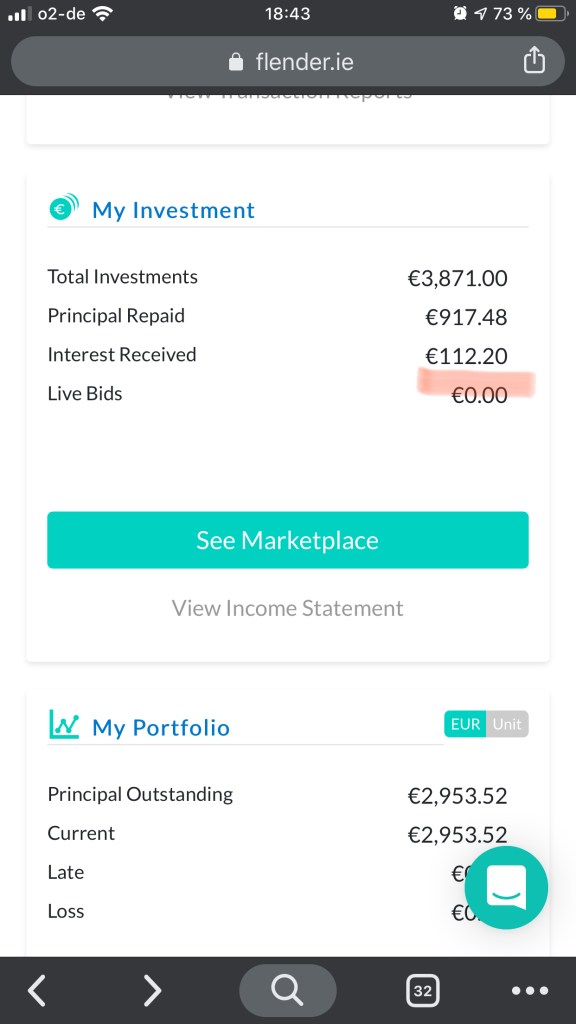
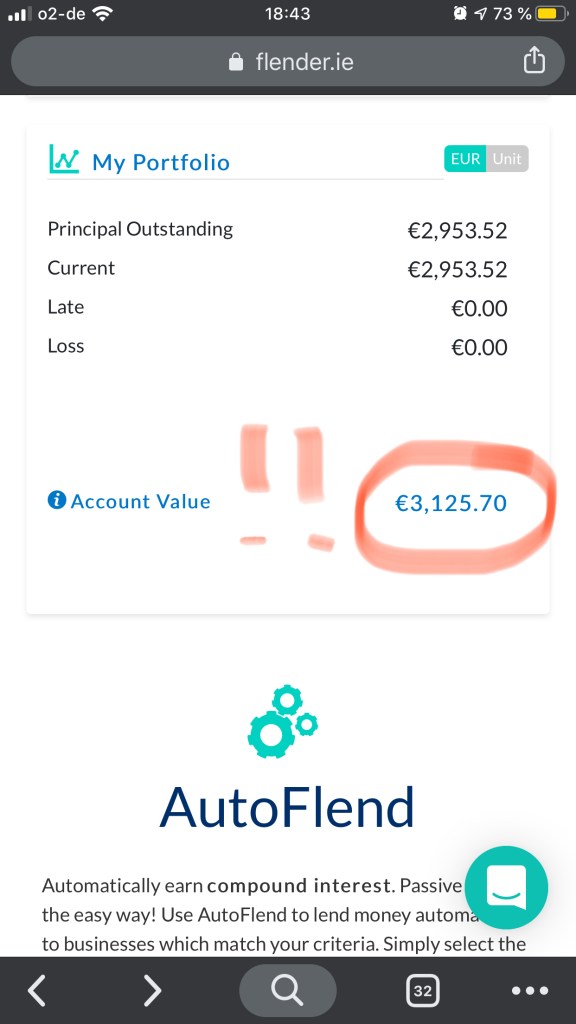
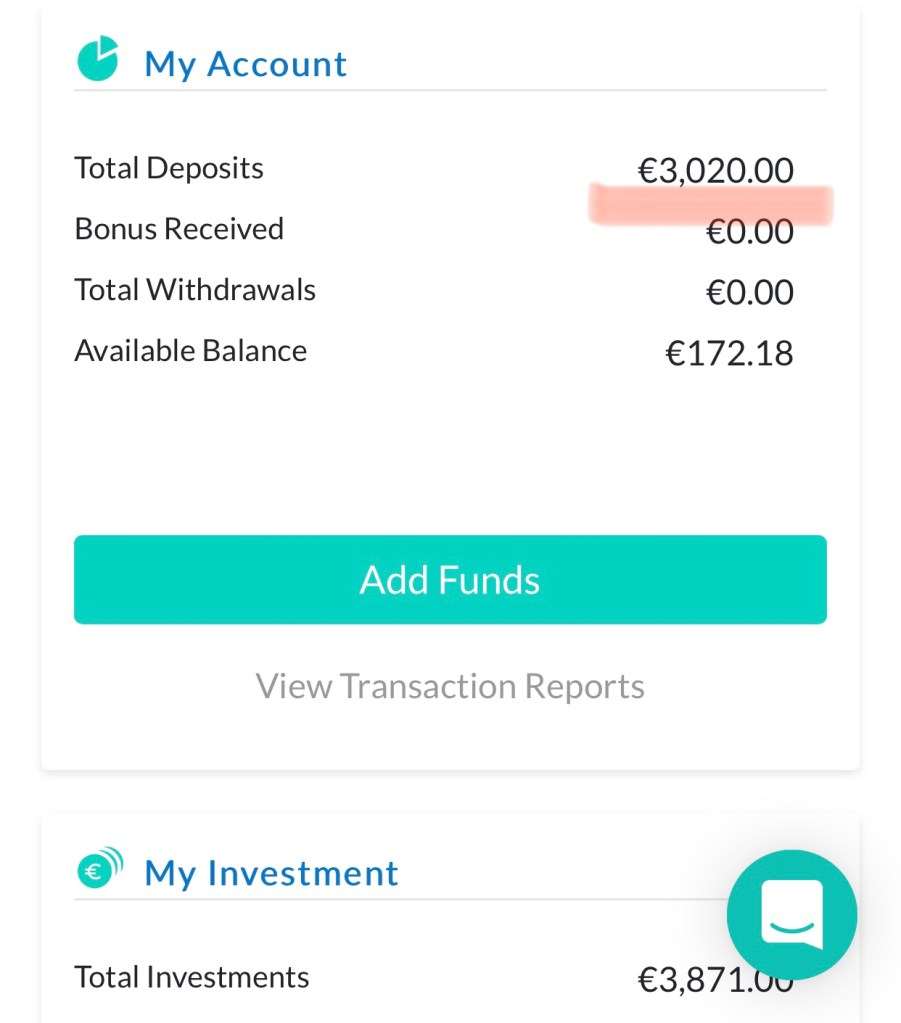
Still trying to let the whole issue go, I was looking at my dashboard a couple of days later when I noticed something peculiar. I had deposited 3,020.00 Euro into my account and had acquired 112.20 Euro. Yet, instead of showing 3,132.20 Euro, my account value was 3,125.70 Euro. I felt relieved – there had been a mistake on their side and if I would reach out to them, they would fix it, surely.

I immediately sent them an email to let them know that the account value wasn’t updating properly – an IT bug probably, easy to be fixed. Imagine my surprise, when I received an email that in fact the account value was correct: because the account value as flender.ie defines it is outstanding principal plus available balance: 2,953.52 Euro + 172.18 Euro = 3,125.70 Euro.

So I sent them another email to point out that if there are no fees, then something is wrong and that they should look into it again. I got the response that I indeed got 112.20 Euro and that the account value as they calculate it, was correct. At this point, anyone would get frustrated and so did I – sent them another email and asked them if they could guarantee that if I removed all my funds, it would be invested funds + total interest received. To which I got yet another reply that I could withdraw the amount in available balance.

flender account balance

Invest in fender.ie?

Yes exactly, Flender.ie is doing some dodgy math acrobatics to trick investors out of some money. I know in my case it’s just a difference of a couple of euro but if they do that to every investor, they will get quite a nice sum out of it.

I did expect them to check and fix their mistake but instead, I got the same answer over and over.

In case someone from the Flender.ie management reads this: if you want to increase your profits, be transparent and introduce fees. Don’t try to fool your investors – your business might not survive it.

To everyone else reading this – I lost trust and confidence in Flender.ie and will remove my funds as soon as I can.

Thank you for reading

About me

Hi, I’m a 35-year old European who is actively working towards her FIRE goal. Even before I came across the concept of investing aggressively to be able to retire early, I vividly remember one encounter, I will never forget: About fifteen years ago, I was working in a bank when a customer explained to me “I’d rather have my money working for me than me working for my money”. Back then it was still the early days of the internet and information about investing was not widely available online as it is today – nor had the fintech industry started revolutionizing the banking sector – so even though I wanted to learn more, I didn’t really know where to start.

Luckily, today I have a strategy – one that is helping me achieve my goals faster than I thought possible – and I want to inspire everyone around me to think about their financial future, too. Therefore, the blog will be about personal finance… and beyond.

Disclaimer:

I’m not giving investment advice. The content of this blog is for educational purposes only and outlines my progress.

The blog may contain affiliate links. If you click on a link, I might earn a commission.

Design a site like this with WordPress.com
Get started